
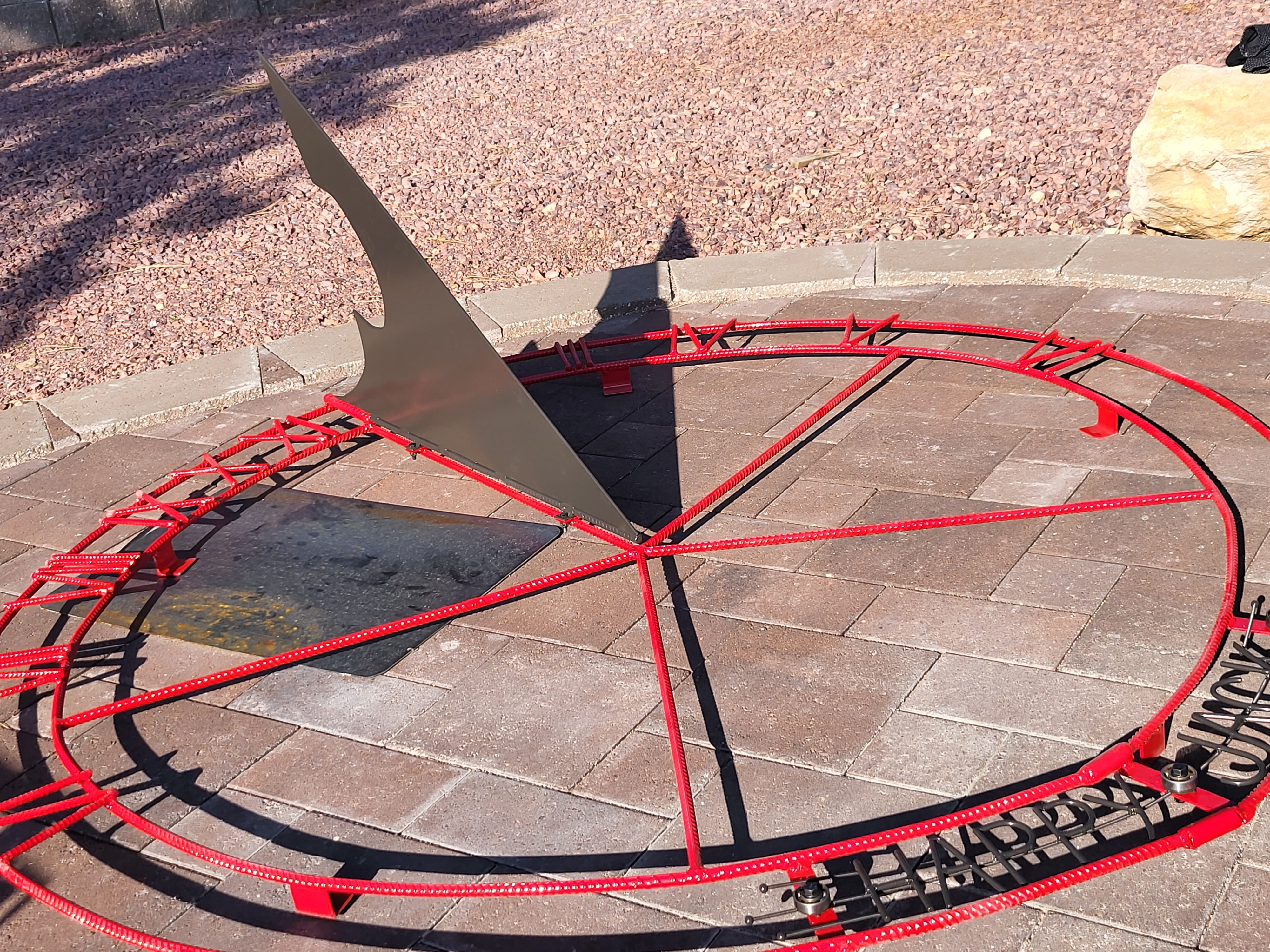
It’s 4 o’clock somewhere.
Sundials were estimated to be ‘invented’ by the ancient Egyptians around 1500 BC. There is evidence going back to 3500BC of a stick or pillar with a triangular ‘wedge’ (known today as a gnomon) to cast shadows to tell time.
Early devices were thought to help farmers tell time such that they would know when to plant and harvest crops. The early Egyptian ‘shadow clocks’ consisted merely of a straight base and raised crosspiece at one end with a scale inscribed in 6 divisions. The semi circle construction wasn’t developed until 280 BC by Greek astronomer Aristarchus of Samos who devised a pointer fixed at one end along a circular arc divided into 12 equal divisions.

Early versions of the sundial did not account for the seasons and length of the day. The sundial continued to iterate and become more sophisticated with factions across the world refining the design. Babylonian astronomer Berosus invented a spherical surface that traced a shadow tip for the longest day of the year. Around 100 BC that the Greeks began experimenting with vertical, horizontal, and inclined dials. The Roman’s employed seasonal hours, and even some portable sundials.

Over time, sundials became more complex and more accurate. Modern astronomers and mathematicians adjusted for the Earth’s tilted axis, the length of the shadow (longer in the winter than summer). Gnomon’s (the triangular pointer) were devised to cast a shadow to tell time and were eventually designed to point north versus straight up.

Eventually, the sundial became so accurate that it was the basis to check and adjust mechanical clocks until the late 1900’s.
Today, sundials are primarily ornamental, and use embellishments to make them unique and individual. Many incorporate mottos or whimsical sayings, like German’s wit, ‘Do like a sundial, count only the sunny days.’
See our own efforts to replicate an ancient scientific development…. https://kritterspaw.com/2023/10/15/dont-do-this-at-home/
 kritterspix